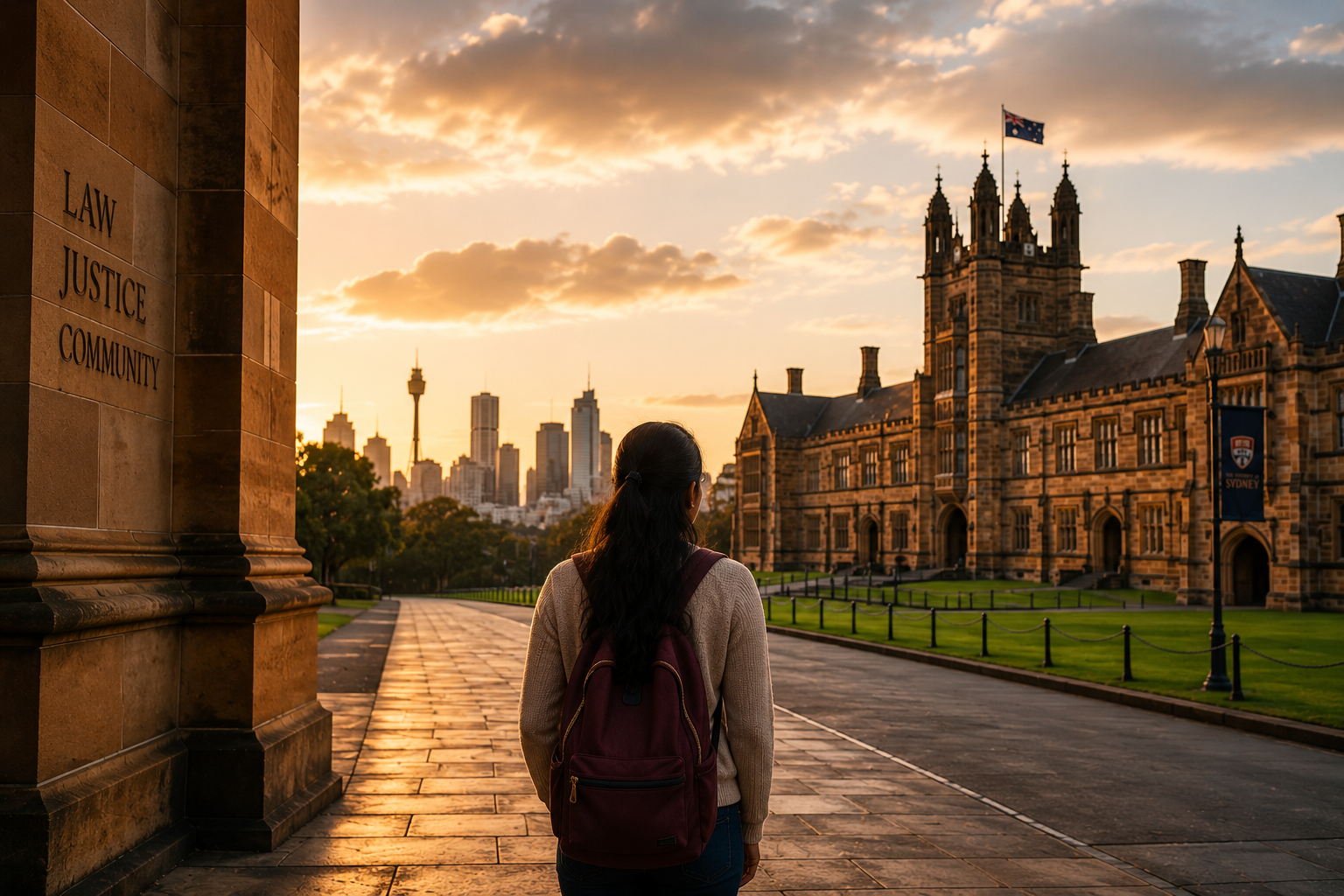
When the Law Leaves You Between Two Worlds: The International Student and the Injustice of Uncertainty
Summary
Australia’s international student system is built on temporary migration, and studying here does not create an entitlement to permanent residence. Yet for many students, years spent studying, working and building connections in Australia create a growing divide between legal temporary status and genuine social and economic belonging.
This article examines whether that uncertainty raises a broader question of fairness. Drawing on the lived experience of an international law student and Australian migration data, it argues not for automatic permanent residence, but for clearer and more predictable pathways that better recognise graduates who have developed valuable skills, established themselves in Australian workplaces and communities, and demonstrated a capacity to contribute over the longer term.
The question is therefore not simply whether international students should be allowed to stay, but whether Australia could become better at identifying—and retaining—the graduates it has good reason to want to keep.
In February 2022, at the age of twenty-one, I arrived in Australia to study law. I came with the optimism of someone beginning a new life: excited to learn, meet people, become independent and build a future in a country far from home.
I understood that moving overseas would be difficult. What I did not anticipate was how profoundly immigration law would shape almost every aspect of my life.
For an international student, the law is not something encountered only in a courtroom or a statute book. It is present in decisions about work, education, finances, accommodation and, ultimately, whether one is permitted to remain in the country in which one has spent years building a life.
That experience has led me to consider a difficult question: when does the lawful operation of a system begin to raise questions of fairness?
The Law of Temporary Belonging
International students enter Australia under a legal framework that deliberately makes their presence temporary. That distinction is understandable. A student visa is not, by its nature, a promise of permanent residence.
Yet the lived reality is more complicated.
A student may spend several years studying in Australia, paying substantial tuition fees, working within prescribed limits, developing professional skills, forming friendships and becoming part of a community. By graduation, Australia may no longer feel like a temporary destination.
It may feel like home.
Yet legally, the individual may remain temporary.
That creates a peculiar form of insecurity: one can belong socially while remaining uncertain legally.
The difficulty is not necessarily that the law is unclear. Often, it is precisely because the law is clear that the uncertainty becomes difficult. A person may understand their visa conditions perfectly and still have no certainty that the pathway they are planning today will remain available tomorrow.
The Price of Uncertainty
The financial consequences of this uncertainty are substantial.
International students pay considerable amounts for their education and living expenses. After graduation, further visa applications can involve costs of several thousand dollars, while pathways towards permanent residence may require significantly greater financial and professional commitments.
These are not abstract expenses. They are decisions made by individuals and families who are investing in a future that may remain conditional.
My own family has supported me throughout this journey. Like many families who send their children overseas, they have invested not only money but hope. They have watched me navigate study, employment, visa requirements and the uncertainty of what comes next.
The difficult question is not whether immigration law should regulate who may remain in Australia. It plainly must.
The difficult question is whether a person who has complied with the law at every stage should nevertheless have to live with such profound uncertainty about the future.
When the Law Shapes Educational Choices
Immigration law also influenced how I approached my education.
During my fourth year of law school, I undertook subjects from the following year and studied during university vacation periods so that I could complete my degree sooner. My motivation was partly academic, but it was also legal and practical.
I wanted to complete my degree and become eligible for a Temporary Graduate visa, which would provide greater flexibility to work full-time.
This experience made me conscious of something that is rarely visible in discussions about international education: immigration law can influence academic decisions.
The decision about when to graduate is not necessarily just a university decision. It can become a visa decision.
The decision about whether to pursue further study can become a migration decision.
The decision about accepting employment can become a question of visa conditions.
In this way, immigration law reaches beyond immigration itself. It can quietly shape the ordinary decisions through which a young person constructs their future.
Inequality of Uncertainty
One of the most striking aspects of my experience has been that the consequences of immigration status do not always operate through an explicit prohibition.
Sometimes they operate through uncertainty.
During my studies, I encountered difficulties finding employment that could accommodate the restrictions attached to my student visa. Later, after obtaining professional experience, another question became increasingly relevant: how long would I have the right to remain?
For an employer, asking about visa duration may be a reasonable commercial consideration.
For the person being asked, however, it can feel as though their legal status has become more important than their education, experience or potential.
This creates an unusual form of inequality.
Two people may possess comparable qualifications and abilities, yet one may have certainty about their right to work while the other must continually explain the legal conditions attached to their employment.
The law may treat the distinction as necessary.
The individual experiences it as a barrier.
That gap between legal justification and lived experience is where questions of injustice begin.
The Moving Goalposts
There is another dimension to this problem: change.
Immigration policy must evolve. Governments have legitimate reasons to change visa settings, address labour-market conditions, manage population growth and respond to economic and social pressures.
But people make decisions based on the law as it exists when those decisions are made.
A student chooses a course.
A family commits financially.
A person builds professional experience.
A graduate decides whether to remain in Australia or return home.
When the legal environment changes, those decisions may suddenly acquire a different meaning.
The law may have changed prospectively and lawfully. Yet, from the perspective of the person whose plans have been disrupted, the experience can feel retrospective.
This is one of the most difficult aspects of immigration law: the state regulates the future, while individuals have already invested in it.
Is it Unjust Because it is Difficult?
It would be simplistic to describe immigration law as unjust merely because it produces difficult outcomes.
The state has a legitimate interest in determining who may enter, work and remain in Australia. Visa conditions serve important policy purposes. Permanent residence is not an entitlement simply because a person has studied in Australia.
But legality and justice are not always synonymous.
A law may be validly enacted and consistently applied while still producing outcomes that invite questions of fairness.
The international student may comply with every condition, pay every required fee, complete an Australian qualification and contribute to the economy and community, yet still face uncertainty about whether there is a place for them in the country they have spent years calling home.
That does not necessarily make the law unlawful.
It does, however, make it worthy of examination.
The Human Being Behind the Visa
It is easy to discuss international students through statistics: numbers of arrivals, tuition revenue, visa grants, migration places and employment figures.
But the law operates upon individuals.
Behind every visa application is someone who may have left their parents for the first time.
Someone who is learning to navigate a new legal and social system.
Someone who may be supporting themselves while studying.
Someone who may be making life-changing decisions based upon legislation and policy that they did not create and cannot control.
I have experienced both sides of this reality.
Australia has challenged me, but it has also welcomed me. I have met remarkable people, developed meaningful friendships and worked for employers who treated me with genuine kindness. I have been invited to Christmas lunches and welcomed into workplaces in ways that made a country thousands of kilometres from my family feel like home.
That is why my criticism is not directed at Australia or at the people who have welcomed me.
It is directed at a broader question of law and fairness.
What Does Justice Require?
Perhaps justice does not require immigration law to guarantee permanent residence.
Perhaps it cannot.
But justice may require us to consider what happens when people are encouraged to invest years of their lives, substantial financial resources and their professional futures in a country while the legal pathway beyond temporary status remains uncertain.
The question is not whether every international student should be permitted to stay.
The question is whether the law sufficiently recognises the human consequences of uncertainty.
At twenty-one, I came to Australia believing I was simply beginning a degree.
I did not realise that I was also entering a legal system that would influence when I studied, how I worked, what I could afford and how I imagined my future.
Four years later, I remain grateful for the opportunities Australia has given me.
But gratitude should not prevent reflection.
The experience of an international student demonstrates that injustice does not always arise from a law being obviously oppressive, discriminatory or unlawful. Sometimes it arises in the space between what the law permits and what fairness appears to require.
For those of us who have lived that uncertainty, the most difficult part is not knowing that the law has rules.
It is knowing that our lives must be planned around rules that may change, while the consequences of those changes remain ours to carry.
That is the quiet injustice of temporary belonging: the law may give you permission to build a life, while never giving you certainty that you will be allowed to keep it.